Home › Products › Cloth gift wrap printing › Polyester spun
Polyester spun furoshiki printing
Furoshiki cloths on polyester spun by sublimation, Okhla, Delhi: about 4 furoshiki cloths from 3 m of typical 58-inch polyester spun.
Is polyester spun right for furoshiki cloths?
Polyester spun suits furoshiki cloths: it is soft and easy to handle and it keeps the cost per piece low. Printed with sublimation: bright, even colour; logos and text print crisp.
Trade-off: It is at the heavy end for furoshiki cloths: more body, but stiffer to stitch and fold. If that matters, choose cotton cambric for a lighter, softer piece.
Design tips: Put a motif in each corner: the corners are tied into the knot and show on top. On polyester spun, logos, text and flat brand colours print crisp and even.
Print your own design: send the artwork and the furoshiki size, and we print a sample on polyester spun before the run. Order the printed fabric only, or ready furoshiki cloths stitched in-house.
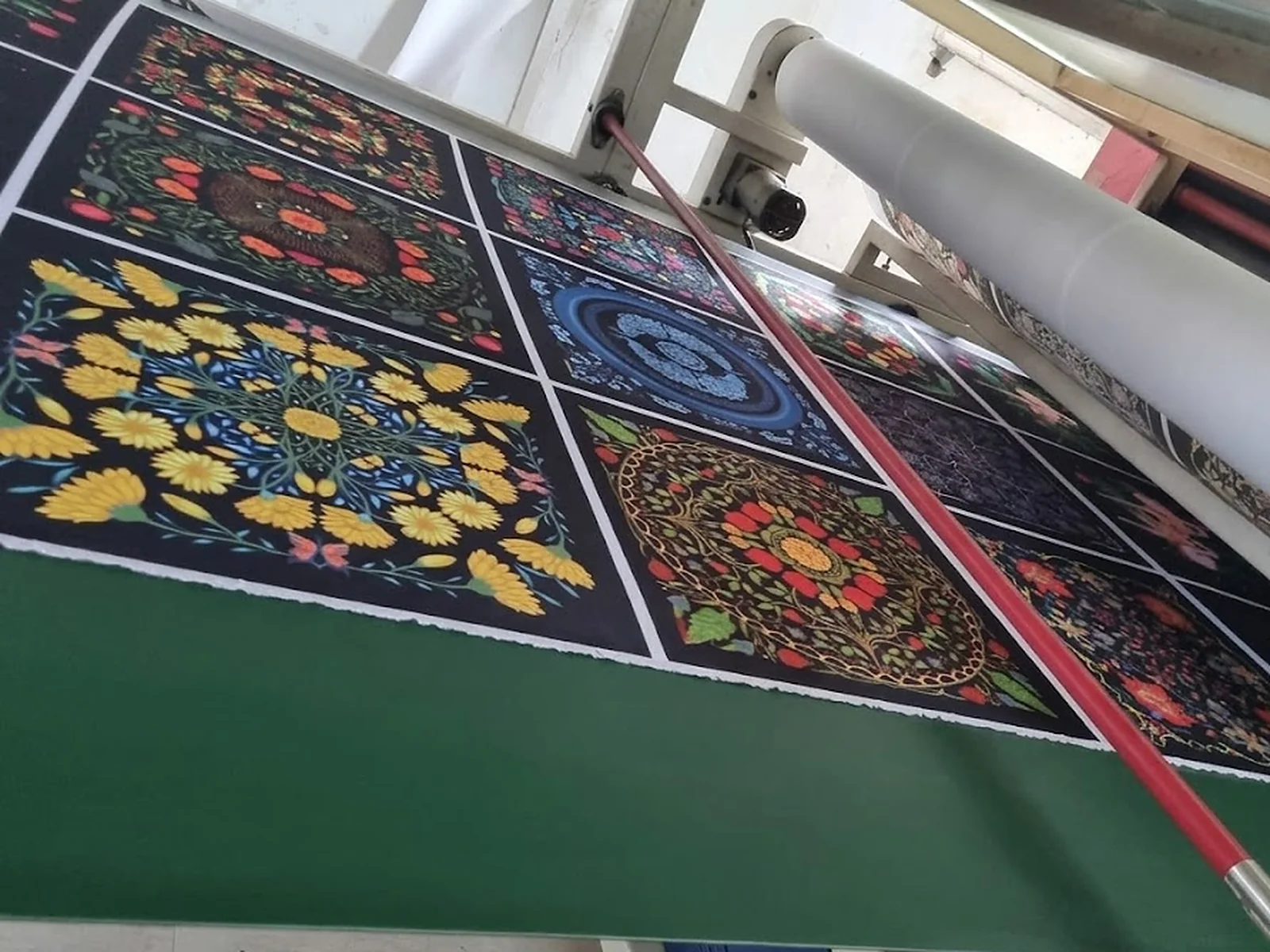
Furoshiki cloths on polyester spun: size and yield
| Typical finished size | 70 x 70 cm (cut 72 cm); 50 cm and 90 cm squares |
|---|---|
| On 58-inch fabric (about 143 cm usable) | 4 furoshiki cloths from 3 m (1 across × 4 down = 4 pieces of 72 × 72 cm) |
| Fabric for 10 furoshiki cloths | About 7.2 m of 58-inch fabric, before any extra for samples |
| Weight of fabric used per piece | About 62-93 g per furoshiki, before trims and packing |
| How it is counted | Pieces are counted on the usable width (fabric width less about 4 cm of selvedge) across a 3 m length, trying both directions. |
| Finishing options | Rolled or narrow hems, packed flat |
Polyester spun at a glance
| Hand-feel and drape | Medium weight, soft and cotton-like |
|---|---|
| Sheen | Matte |
| Opacity | Opaque |
| Typical weight / width | Typical 120-180 gsm; typical width 58″ |
| How the print looks | Sublimation: Bright, even colour; logos and text print crisp |
| Care | Cool machine wash; dries quickly |
| Good for | Flags, backdrops, table flags, napkins, aprons |
| Not ideal for | Luxury silk-look items |
How polyester spun meets what furoshiki cloths need
| Weight: furoshiki cloths work on very light to medium-weight fabric | Polyester spun is medium-weight, typical 120-180 gsm, at the heavy end of that range. |
|---|---|
| Opacity: furoshiki cloths need at least a semi-opaque fabric | Polyester spun is opaque with room to spare. |
| Drape: furoshiki cloths handle best in a soft or fluid fabric | Polyester spun is soft, a match. |
On 58-inch polyester spun, 1 cut piece of 72 cm sit across the 143 cm usable width, leaving about 71 cm (50% of the width) as offcut on every row.
Making furoshiki cloths in polyester spun
Polyester spun is medium-weight, so it takes the usual furoshiki finish without special handling: rolled or narrow hems.
What the print process means here
Furoshiki cloths in polyester spun are printed by sublimation, the process for polyester: heat turns the dye to a gas that enters the fibre, so nothing sits on the surface to crack when the furoshiki is folded. Polyester spun is opaque, so the reverse of a furoshiki stays much paler than the printed face. Digital printing has no white ink, so any white in a furoshiki design is the colour of the polyester spun itself.
Polyester spun or peach-finish polyester for furoshiki cloths?
Against peach-finish polyester, polyester spun for furoshiki cloths is heavier (typical 120-180 gsm against 80-120 gsm). Pick polyester spun for a heavier furoshiki; pick peach-finish polyester for a lighter one. See peach-finish polyester furoshiki cloths.
Other fabrics for furoshiki cloths
- Peach-finish polyester furoshiki printing: lighter than polyester spun, about 4 from 3 m
- Cotton slub furoshiki printing: close to polyester spun, about 4 from 3 m
- Cotton satin furoshiki printing: glossier than polyester spun, about 4 from 3 m
- Polyester crepe furoshiki printing: lighter and sheerer than polyester spun, about 4 from 3 m
Other products in polyester spun
- Polyester spun uniform printing: about 1 uniform from the 3 m that makes 4 furoshiki cloths
- Polyester spun pet bandana printing: about 20 pet bandanas from the 3 m that makes 4 furoshiki cloths
- Polyester spun scarf printing: about 3 scarves from the 3 m that makes 4 furoshiki cloths
- Polyester spun cushion cover printing: about 6 cushion covers from the 3 m that makes 4 furoshiki cloths
Specification
| Printing process | Sublimation on polyester (two Mimaki printers) |
|---|---|
| Fabrics | Polyester spun |
| Typical fabric weight | Typical 120-180 gsm (typical width 58″) |
| Sizes | 70 x 70 cm (cut 72 cm); 50 cm and 90 cm squares |
| Order as | Printed fabric only, or the ready finished product, stitched and packed in-house |
| Finishing options | Rolled or narrow hems, packed flat |
| Minimum order | From 3 metres of fabric, or a few sample pieces, including finished pieces |
| Turnaround | Sample first; sample and bulk dates are confirmed with your quote |
| Care | Cool machine wash; dries quickly. Furoshiki cloths in polyester spun wash cool, dry fast and need little ironing. |
- Any MOQ — from 3 metres, or a few sample pieces
- Competitive per-metre pricing — ask for a quote
- In-house digital printing unit at S-73, Okhla Industrial Area Phase II, New Delhi, since 1996
- In-house tailoring: printed fabric only, or the ready stitched product
Frequently asked questions
Is polyester spun good for furoshiki cloths?
Polyester spun suits furoshiki cloths: it is soft and easy to handle and it keeps the cost per piece low. It is at the heavy end for furoshiki cloths: more body, but stiffer to stitch and fold.
How many furoshiki cloths can I get from 3 metres of polyester spun?
On 58-inch fabric (about 143 cm usable): 4 furoshiki cloths from 3 m (1 across × 4 down = 4 pieces of 72 × 72 cm). Fabric for 10 furoshiki cloths: about 7.2 m of 58-inch fabric, before any extra for samples. Weight of fabric used per piece: about 62-93 g per furoshiki, before trims and packing. Sizes and yields are typical; we confirm them with your quote.
Can you deliver ready furoshiki cloths in polyester spun, or only the printed fabric?
Both: our in-house tailoring stitches the furoshiki cloths, or you take the printed polyester spun only. Polyester spun is medium-weight, so it takes the usual furoshiki finish without special handling: rolled or narrow hems.
How do I wash a printed polyester spun furoshiki?
Cool machine wash; dries quickly. Furoshiki cloths in polyester spun wash cool, dry fast and need little ironing. Sublimated colour is inside the polyester fibre, so it does not crack or peel.
What can I use instead of polyester spun for furoshiki cloths?
Cotton cambric, for a lighter, softer piece. Cotton cambric is light, fine and soft; a little softer than poplin.
How does polyester spun compare with cotton slub for furoshiki cloths?
Against cotton slub, polyester spun for furoshiki cloths is polyester where cotton slub is cotton; easy-care polyester (cool machine wash, dries fast) where cotton slub is machine-washable; and lower in cost. Pick polyester spun for an easier-care and lower-cost furoshiki; pick cotton slub for a natural-fibre one.
What is the minimum order quantity for polyester spun furoshiki cloths?
Any MOQ — from 3 metres, or a few sample pieces. 3 m of polyester spun already makes about 4 furoshiki cloths, so a sample run can be a small batch.
How is the price of polyester spun furoshiki cloths worked out?
Competitive per-metre pricing, quoted for your design and quantity. For furoshiki cloths, polyester spun sits in the lowest cost band of the bases we print, and ready furoshiki cloths add stitching and finishing to the printed fabric.
Questions about cloth gift wrap and polyester spun
Get a quote for polyester spun furoshiki cloths
Send your design, the size and the quantity. We reply with the price and a sample plan.
HM International
Okhla Industrial, S-73, Sanjay Colony II, Pocket Y, Sanjay Colony, Okhla Phase II, Area, New Delhi, Delhi 110020
| Monday | 10 am – 7 pm |
| Tuesday | 10 am – 7 pm |
| Wednesday | 10 am – 7 pm |
| Thursday | 10 am – 7 pm |
| Friday | 10 am – 7 pm |
| Saturday | 10 am – 7 pm |
| Sunday | Closed |