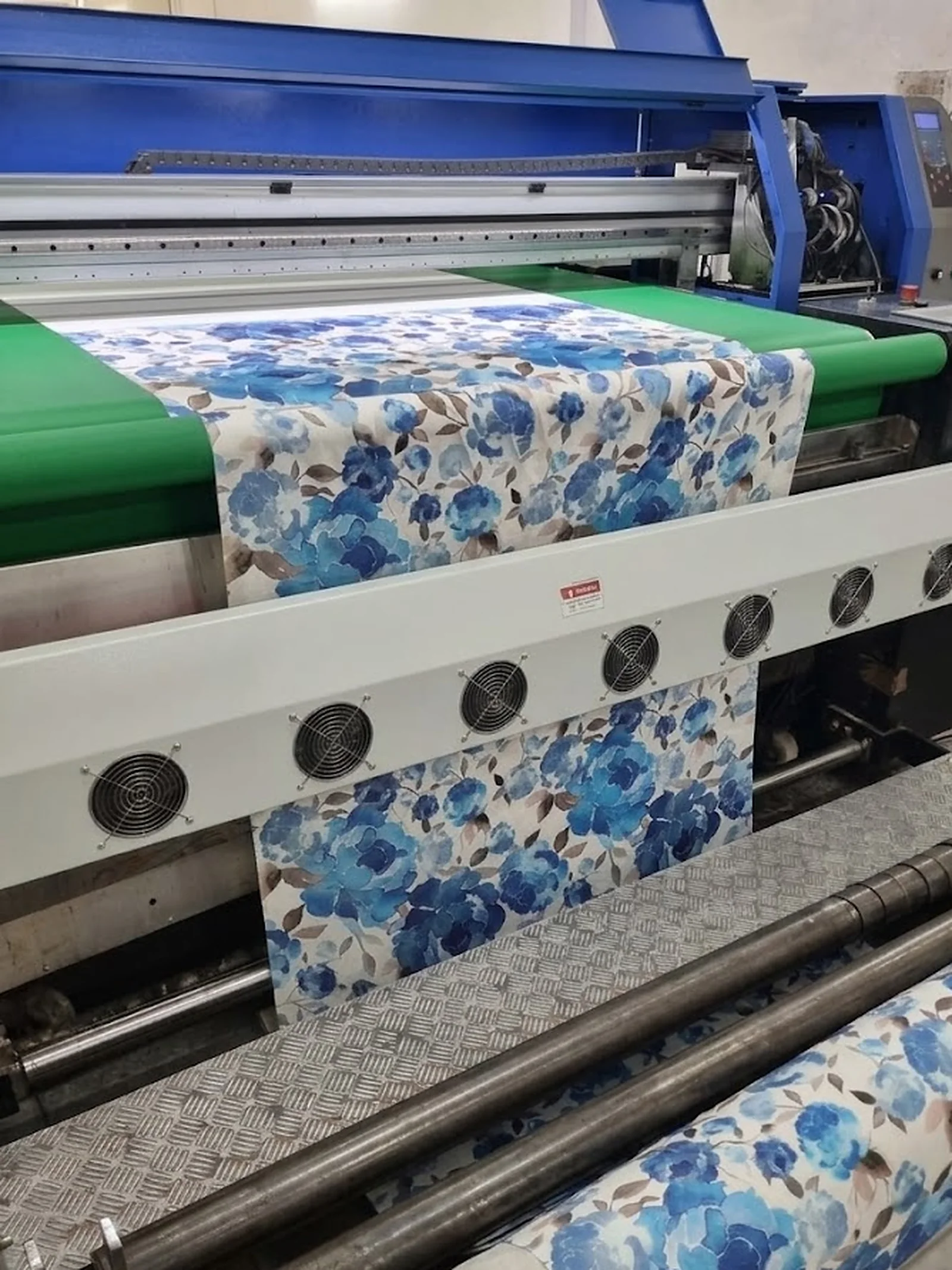
Short answer: on fabric, dye sublimation is a heat-transfer method. “Heat transfer” is the wider family: any process that prints a design onto a carrier and then applies it with heat and pressure. Direct digital printing is different again: it prints straight onto the fabric.
Heat transfer: the family
All heat-transfer printing works in two steps: print the design onto paper or film, then press it onto the material with heat. What changes is what moves onto the fabric. With sublimation only the dye moves, and it goes into the fibre. With film or vinyl transfers, a layer of film and ink is bonded to the surface. That layer can be felt, and it is what can crack or peel over time.
Sublimation: dye into the fibre
Sublimation inks are disperse dyes. Under heat they turn into a gas, the polyester fibres open, take in the dye, and close again as they cool, locking the colour inside. The result has no hand feel and washes well. The limit is the fibre: it needs polyester or a high-polyester blend, and it shows best on white or light bases.
Sublimation can also be done direct: the disperse ink is printed straight onto polyester and then fixed with heat, so no transfer paper is used. It is still the same dye chemistry.
Direct digital printing: ink straight onto the fabric
Natural fibres such as cotton, silk, viscose, linen and wool do not take sublimation dye. They are printed directly, with ink chosen for the fibre: reactive dyes for cellulose fibres such as cotton, acid dyes for wool and nylon, or pigment with a binder for a wide range of fabrics. See which ink for which fabric.
Side by side
| Sublimation (heat transfer) | Film / vinyl heat transfer | Direct digital printing | |
|---|---|---|---|
| How | Printed on paper, dye moved into the fibre by heat | Printed film pressed onto the surface | Printed straight onto the fabric, then fixed |
| Fabrics | Polyester and high-polyester blends | Cotton, polyester, dark fabrics | Natural, synthetic and blended, with the right ink |
| Feel | None: the dye is inside the fibre | A layer on top | Depends on the ink; dyes leave the hand unchanged |
What we offer
HM International runs two processes: direct digital printing on all qualities of fabric, and sublimation (heat-transfer) printing for polyester. We do not do film or vinyl transfers.