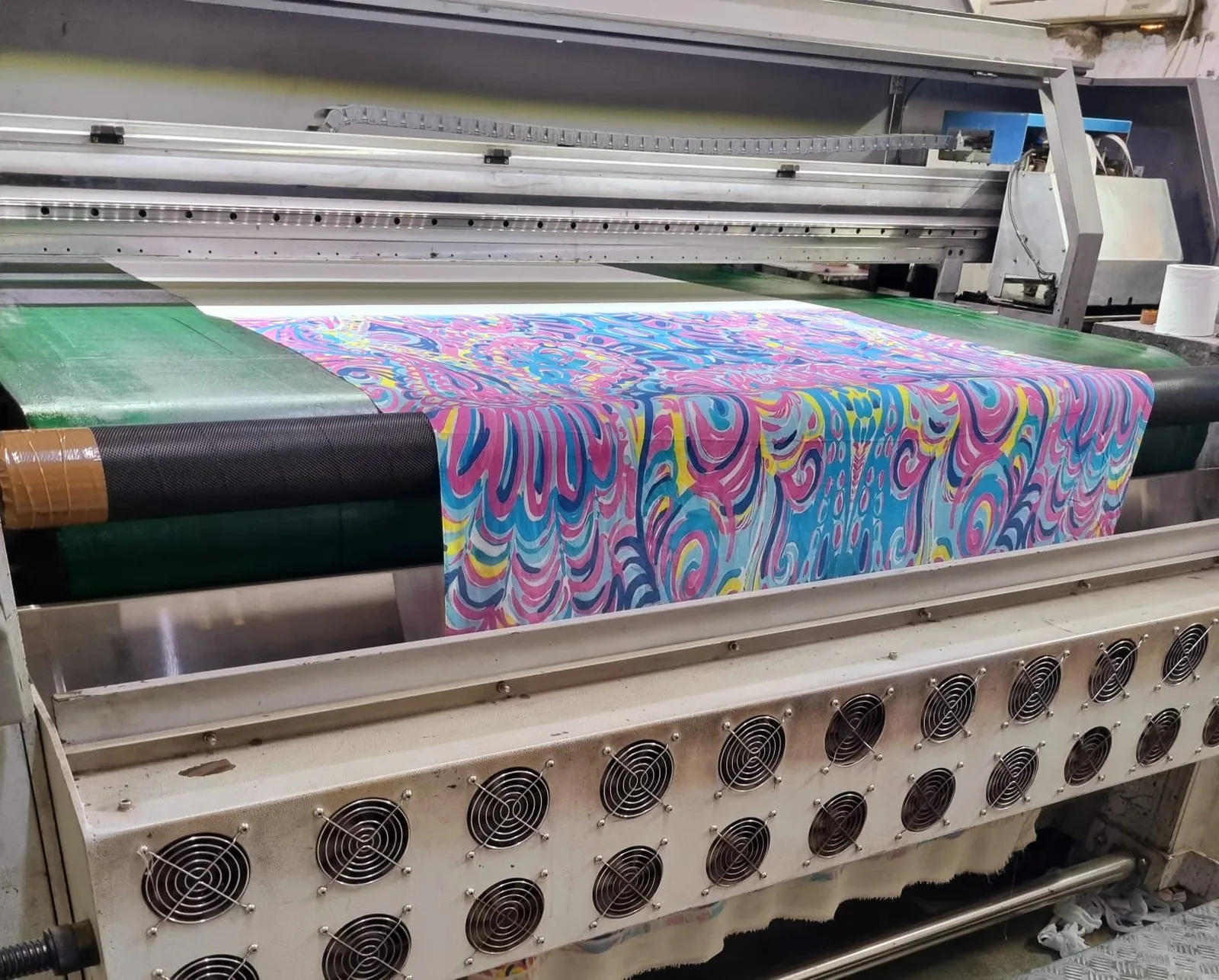
How does reactive printing differ from sublimation on the machine?
Reactive printing puts dye straight onto pre-treated cloth, and the colour is fixed later by steam. Sublimation usually prints onto transfer paper first, and heat then moves the dye into the polyester.
How do reactive and sublimation printing compare, point by point?
For reactive and sublimation printing, the table below sets it out. The fabric counts come from the list of bases we print.
| Point | Reactive | Sublimation |
|---|---|---|
| Fibre | Cellulose, silk and wool | Polyester |
| Dye class | Reactive | Disperse |
| Bases on our list | 22 | 9 |
| Fixing | Steam, then wash | Heat |
| Wash-off water | Yes | No |
| Colour sits | Bonded to the fibre | Inside the fibre |
How do reactive and sublimation prints feel?
Reactive and sublimation prints both leave the hand of the fabric much as it was, because neither adds a layer on top. The feel you get comes from the base cloth, so a cotton stays a cotton and a polyester satin stays slippery.
Which should you choose, reactive or sublimation?
Choose reactive when the product needs a natural fibre, skin comfort or absorbency. Choose sublimation when it needs easy care, sharp colour on polyester and a lower base cost. We run both, and we tell you which one applies once we know the fabric.