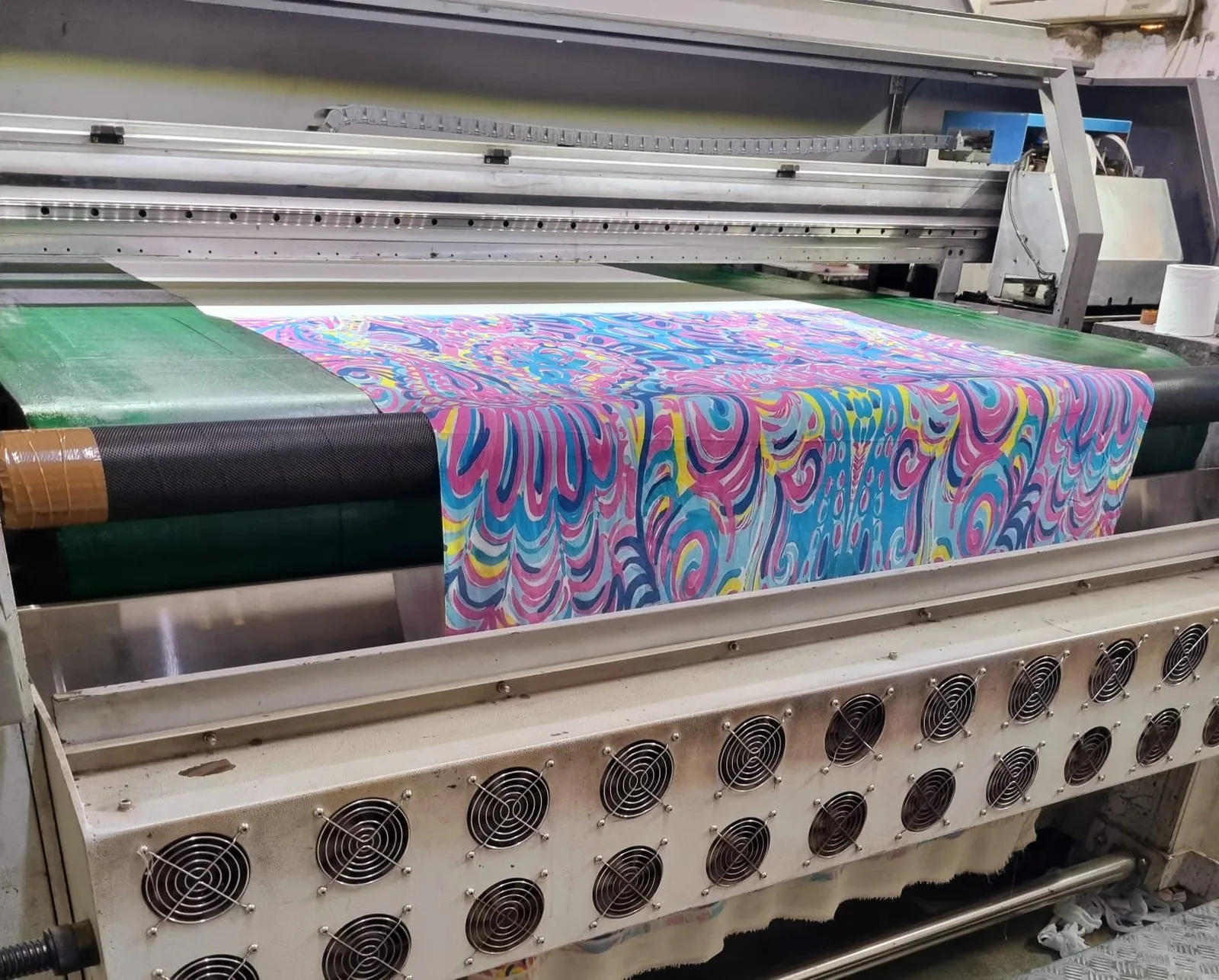
How does a disperse dye enter polyester?
A disperse dye enters polyester when heat, typically around 180-210 °C, loosens the fibre’s structure and turns the dye to gas. When the fabric cools the structure closes again, trapping the colour within the fibre.
How does disperse dye look on each polyester base?
For disperse dye, the table below gives the figures. From our fabric data; weights are typical.
| Polyester base | Typical weight | Print result |
|---|---|---|
| polyester satin | 90-120 gsm | The brightest, sharpest colour of all; the dye is inside the fibre, so it cannot crack |
| peach-finish polyester | 80-120 gsm | Bright, sharp colour on a soft matte face |
| polyester roto | medium weight | Bright colour on a cotton-look surface |
| polyester spun | 120-180 gsm | Bright, even colour; logos and text print crisp |
| polyester chiffon | 40-60 gsm | Bright colour that shows through to the back |
| polyester crepe | 100-140 gsm | Bright colour, slightly softened by the crepe grain |
| polyester canvas | 200-300 gsm | Bright, durable colour on a firm surface |
| knitted polyester | 100-115 gsm | Bright colour that passes through to the reverse, mirrored |
| polyester lycra | 180-250 gsm | Bright colour that does not crack when stretched |
Why does a disperse dye not suit cotton?
A disperse dye does not suit cotton because cellulose does not hold it, so most colour washes straight out. A blend takes colour only on its polyester, which is why a poly-cotton looks paler.
What does a disperse dye look like on different polyester?
A disperse dye gives bright colour on all polyester, but the face changes the look: high sheen on satin, a matte look on spun, and a show-through on chiffon and flag knit. The table shows each.