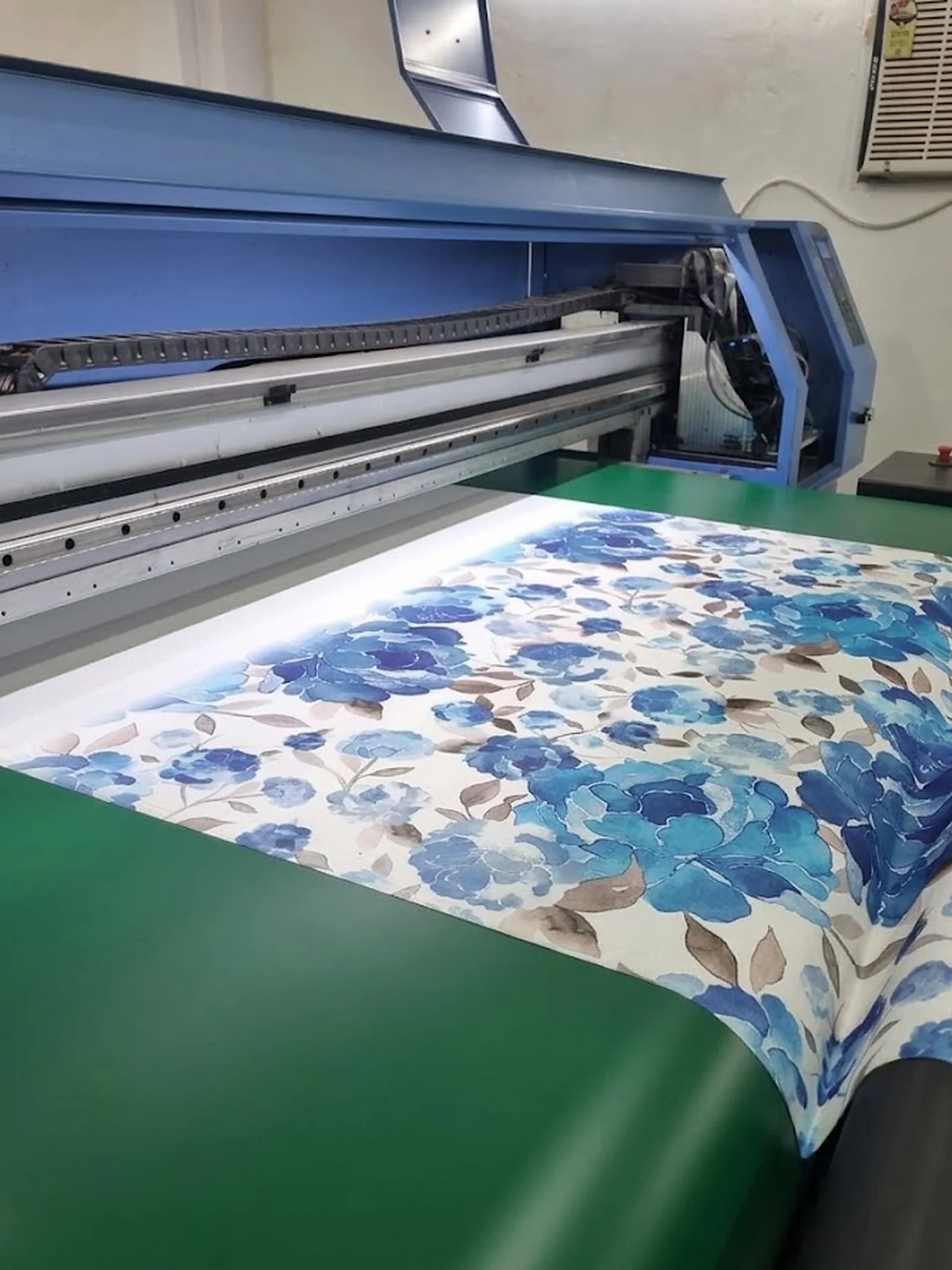
What are the main advantages of digital printing on fabric?
Digital printing on fabric has no set-up for each colour, so short runs and many designs make sense. Gradients and photos print as they are, and a design can change between samples at little cost.
How do the pros and cons of digital printing weigh up?
For digital printing on fabric, the table below sets it out. A plain summary for planning.
| Point | Digital printing | What it means for you |
|---|---|---|
| Colours | Advantage | A design with many colours costs no more to set up |
| Photos and gradients | Advantage | Fine shading prints as drawn |
| Small orders | Advantage | Any MOQ — from 3 metres, or a few sample pieces |
| Very long runs | Disadvantage | A rotary quote can work out lower per metre |
| White and metallics | Disadvantage | Dye cannot make them on the cloth |
| Colour across fabrics | Disadvantage | Sample each base |
What are the main disadvantages of digital printing on fabric?
Digital printing on fabric can cost more per metre once one design runs very long. Dye cannot add white or metallic effects, and a colour matched on one fabric will not carry to another.
Who gains most from digital printing on fabric?
Digital printing on fabric helps new labels, sample makers and brands with many small designs the most. It suits a large single order less, and that is when a rotary quote is worth comparing.