Home › Products › Kurti fabric printing › Rayon crepe
Rayon crepe kurti printing
Custom kurtis on rayon crepe, printed by reactive dyes in Okhla, Delhi: about 1 kurti from 3 m of typical 44-inch rayon crepe. Fabric or ready-made.
Is rayon crepe right for kurtis?
Rayon crepe suits kurtis: it is one of the usual first choices for this job and it falls in fluid folds. Printed with reactive dyes: rich colour, slightly softened by the crepe grain.
Trade-off: Viscose-type fibres are weaker when wet: wash gently in cold water and expect a little shrinkage on the first wash. If that matters, choose cotton cambric for easier washing.
Design tips: Choose an all-over print for easy cutting, or an engineered panel with a placed yoke and hem border. On rayon crepe, small all-over prints and soft florals suit the crepe grain.
Print your own design: send the artwork and the kurti size, and we print a sample on rayon crepe before the run. Order the printed fabric only, or ready kurtis stitched in-house.
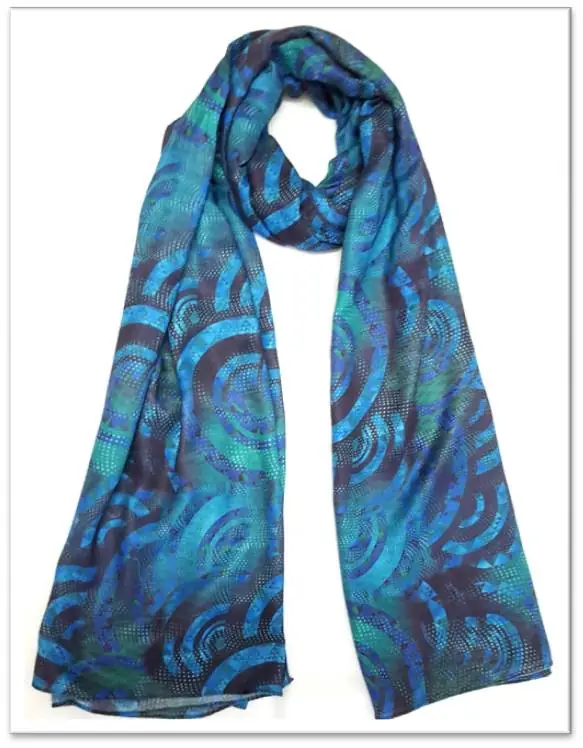
Kurtis on rayon crepe: size and yield
| Typical finished size | About 2.3 m per kurti on 44-inch, less on wider fabric |
|---|---|
| On 44-inch fabric (about 108 cm usable) | 1 kurti from 3 m (about 2.3 m on 44-inch each) |
| Fabric for 10 kurtis | About 23.0 m of 44-inch fabric, before any extra for samples |
| Weight of fabric used per piece | About 283-360 g per kurti, before trims and packing |
| How it is counted | Basis: a kurti takes about 2.3 m of 44-inch fabric; wider fabric needs proportionally less length. |
| Finishing options | Cut and stitched kurtis to your size set, or engineered panels with placed yokes and borders |
Rayon crepe at a glance
| Hand-feel and drape | Fluid, with a fine grainy crepe surface that does not cling |
|---|---|
| Sheen | Matte |
| Opacity | Semi-opaque |
| Typical weight / width | Typical 110-140 gsm; typical width 44″ |
| How the print looks | Reactive: Rich colour, slightly softened by the crepe grain |
| Care | Gentle cold wash or dry clean; may shrink if washed hot |
| Good for | Kurtis, sarees, dupattas, kaftans |
| Not ideal for | Crisp, structured shapes |
How rayon crepe meets what kurtis need
| Weight: kurtis work on very light to medium-weight fabric | Rayon crepe is light, typical 110-140 gsm, inside that range. |
|---|---|
| Opacity: kurtis can be sheer | Rayon crepe is semi-opaque with room to spare. |
| Drape: kurtis handle best in a soft or fluid fabric | Rayon crepe is fluid, a match. |
Rayon crepe comes in a typical 44-inch width, the width the 2.3 m per kurti is based on; the same kurti cut from a 58-inch fabric would need about 1.7 m.
Making kurtis in rayon crepe
Rayon crepe is light, so it takes the usual kurti finish without special handling: cut and stitched kurtis to your size set. Rayon crepe can shrink a little in its first wash, so stitched kurtis in it should be sized with that in mind.
What the print process means here
Kurtis in rayon crepe are printed with reactive dyes, because rayon crepe is a regenerated cellulose fibre; the dye bonds to the fibre, and the fabric is then steamed and washed off, so the hand of the kurti stays soft with no coating on top. Rayon crepe is semi-opaque, so the design shows faintly on the back of a kurti. Digital printing has no white ink, so any white in a kurti design is the colour of the rayon crepe itself.
Rayon crepe or viscose rayon for kurtis?
Against viscose rayon, rayon crepe for kurtis is matte where viscose rayon is softly lustrous. Pick rayon crepe for a more matte kurti; pick viscose rayon for a glossier one. See viscose rayon kurtis.
Other fabrics for kurtis
- Viscose rayon kurti printing: glossier than rayon crepe, about 1 from 3 m
- Cotton cambric kurti printing: firmer and easier-care than rayon crepe, about 1 from 3 m
- Modal kurti printing: glossier than rayon crepe, about 1 from 3 m
- Silk crepe kurti printing: close to rayon crepe, about 1 from 3 m
Other products in rayon crepe
- Rayon crepe kaftan printing: about 1 kaftan from the 3 m that makes 1 kurti
- Rayon crepe curtain printing
- Rayon crepe pareo printing: about 1 pareo from the 3 m that makes 1 kurti
- Rayon crepe kids’ outfit printing: about 2 kids’ outfits from the 3 m that makes 1 kurti
Specification
| Printing process | Reactive digital printing (steam fixed, washed off) |
|---|---|
| Fabrics | Rayon crepe |
| Typical fabric weight | Typical 110-140 gsm (typical width 44″) |
| Sizes | About 2.3 m per kurti on 44-inch, less on wider fabric |
| Order as | Printed fabric only, or the ready finished product, stitched and packed in-house |
| Finishing options | Cut and stitched kurtis to your size set, or engineered panels with placed yokes and borders |
| Minimum order | From 3 metres of fabric, or a few sample pieces, including finished pieces |
| Turnaround | Sample first; sample and bulk dates are confirmed with your quote |
| Care | Gentle cold wash or dry clean; may shrink if washed hot. Kurtis in rayon crepe last longest with a cold, gentle wash and drying in shade; do not wring them. |
- Any MOQ — from 3 metres, or a few sample pieces
- Competitive per-metre pricing — ask for a quote
- In-house digital printing unit at S-73, Okhla Industrial Area Phase II, New Delhi, since 1996
- In-house tailoring: printed fabric only, or the ready stitched product
Frequently asked questions
Is rayon crepe good for kurtis?
Rayon crepe suits kurtis: it is one of the usual first choices for this job and it falls in fluid folds. Viscose-type fibres are weaker when wet: wash gently in cold water and expect a little shrinkage on the first wash.
How many kurtis can I get from 3 metres of rayon crepe?
On 44-inch fabric (about 108 cm usable): 1 kurti from 3 m (about 2.3 m on 44-inch each). Fabric for 10 kurtis: about 23.0 m of 44-inch fabric, before any extra for samples. Weight of fabric used per piece: about 283-360 g per kurti, before trims and packing. Sizes and yields are typical; we confirm them with your quote.
Can you deliver ready kurtis in rayon crepe, or only the printed fabric?
Both: our in-house tailoring stitches the kurtis, or you take the printed rayon crepe only. Rayon crepe is light, so it takes the usual kurti finish without special handling: cut and stitched kurtis to your size set. Rayon crepe can shrink a little in its first wash, so stitched kurtis in it should be sized with that in mind.
How do I wash a printed rayon crepe kurti?
Gentle cold wash or dry clean; may shrink if washed hot. Kurtis in rayon crepe last longest with a cold, gentle wash and drying in shade; do not wring them. Reactive colour is fixed by steaming and washing-off, so it is wash-fast; the fibre decides the care.
What can I use instead of rayon crepe for kurtis?
Cotton cambric, for easier washing. Cotton cambric is light, fine and soft; a little softer than poplin.
What is the minimum order quantity for rayon crepe kurtis?
Any MOQ — from 3 metres, or a few sample pieces. 3 m of rayon crepe already makes about 1 kurti, so a sample run can be a small batch.
How is the price of rayon crepe kurtis worked out?
Competitive per-metre pricing, quoted for your design and quantity. For kurtis, rayon crepe sits in the lower-middle cost band of the bases we print, and ready kurtis add stitching and finishing to the printed fabric.
Rayon crepe kurtis by use
Each page sets the size, quantity, finishing and care for one use.
Questions about kurti fabric and rayon crepe
Get a quote for rayon crepe kurtis
Send your design, the size and the quantity. We reply with the price and a sample plan.
HM International
Okhla Industrial, S-73, Sanjay Colony II, Pocket Y, Sanjay Colony, Okhla Phase II, Area, New Delhi, Delhi 110020
| Monday | 10 am – 7 pm |
| Tuesday | 10 am – 7 pm |
| Wednesday | 10 am – 7 pm |
| Thursday | 10 am – 7 pm |
| Friday | 10 am – 7 pm |
| Saturday | 10 am – 7 pm |
| Sunday | Closed |