Home › Products › Uniform fabric printing › Cotton twill
Cotton twill uniform printing
Custom uniforms on cotton twill, printed by reactive dyes in Okhla, Delhi: about 1 uniform from 3 m of typical 58-inch cotton twill. Fabric or ready-made.
Is cotton twill right for uniforms?
Cotton twill suits uniforms: it is one of the usual first choices for this job, it holds a crisp, neat shape and it takes repeated washing. Printed with reactive dyes: deep colour; very fine lines follow the diagonal slightly.
Trade-off: It is at the heavy end for uniforms: more body, but stiffer to stitch and fold. If that matters, choose cotton poplin for a lighter, softer piece.
Design tips: Choose a repeat that hides small stains and suits all sizes in the run. On cotton twill, logos and bold graphics work well; avoid hairlines thinner than about 1 mm.
Print your own design: send the artwork and the uniform size, and we print a sample on cotton twill before the run. Order the printed fabric only, or ready uniforms stitched in-house.
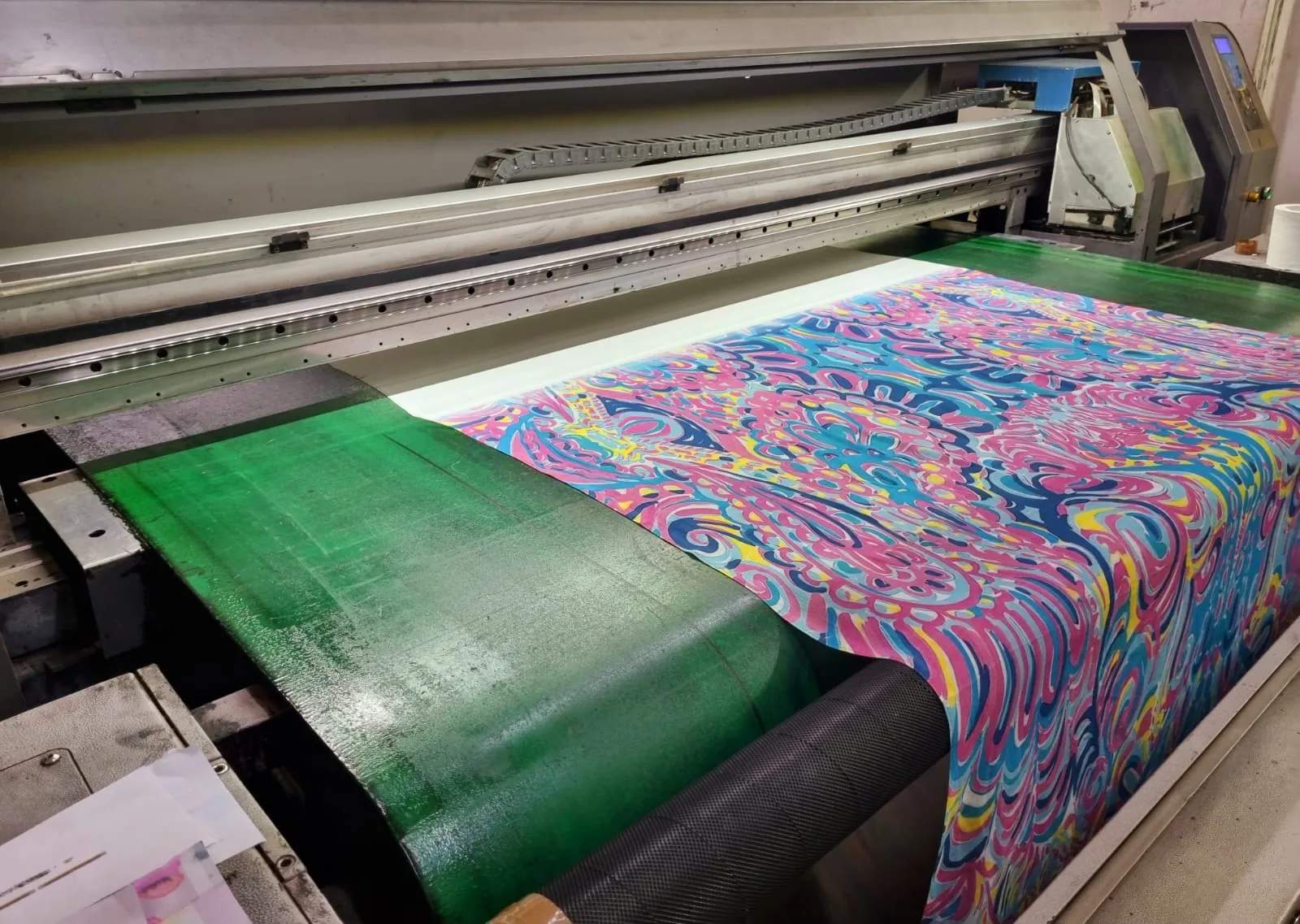
Uniforms on cotton twill: size and yield
| Typical finished size | About 2.3 m per shirt or tunic on 44-inch |
|---|---|
| On 58-inch fabric (about 143 cm usable) | 1 uniform from 3 m (about 2.3 m × 108/143 cm ≈ 1.7 m each) |
| Fabric for 10 uniforms | About 17.4 m of 58-inch fabric, before any extra for samples |
| Weight of fabric used per piece | About 461-640 g per uniform, before trims and packing |
| How it is counted | Basis: a uniform shirt or tunic takes about 2.3 m of 44-inch fabric; wider fabric needs proportionally less length. |
| Finishing options | Cut and stitched shirts, tunics or aprons with logo placement, or fabric by the metre |
Cotton twill at a glance
| Hand-feel and drape | Firm and durable, with a diagonal weave |
|---|---|
| Sheen | Matte |
| Opacity | Opaque |
| Typical weight / width | Typical 180-250 gsm; typical width 58″ |
| How the print looks | Reactive: Deep colour; very fine lines follow the diagonal slightly |
| Care | Machine wash at 40 °C |
| Good for | Aprons, uniforms, tote bags, upholstery, pet beds |
| Not ideal for | Scarves and flowing garments (too stiff) |
How cotton twill meets what uniforms need
| Weight: uniforms work on light to heavy fabric | Cotton twill is heavy, typical 180-250 gsm, at the heavy end of that range. |
|---|---|
| Opacity: uniforms need an opaque fabric | Cotton twill is opaque. |
| Drape: uniforms handle best in a crisp fabric | Cotton twill is crisp, a match. |
| Washing: uniforms are laundered hard and often | Cotton twill is machine-washable. |
Cotton twill comes in a typical 58-inch width, so a uniform takes about 1.7 m instead of 2.3 m on 44-inch, about 24% less length.
Making uniforms in cotton twill
Cotton twill is heavy, so uniforms get firm double-fold hems and strong seams; a fine rolled edge will not hold on it. Cotton twill can shrink a little in its first wash, so stitched uniforms in it should be sized with that in mind.
What the print process means here
Uniforms in cotton twill are printed with reactive dyes, because cotton twill is cotton, a cellulose fibre; the dye bonds to the fibre, and the fabric is then steamed and washed off, which is why the colour holds through the frequent washing uniforms get. Cotton twill is opaque, so the reverse of a uniform stays much paler than the printed face. Digital printing has no white ink, so any white in a uniform design is the colour of the cotton twill itself.
Cotton twill or linen cotton for uniforms?
Against linen cotton, cotton twill for uniforms is heavier (typical 180-250 gsm against 120-180 gsm); and lower in cost. Pick cotton twill for a heavier and lower-cost uniform; pick linen cotton for a lighter one. See linen cotton uniforms.
Other fabrics for uniforms
- Linen cotton uniform printing: lighter than cotton twill, about 1 from 3 m
- Linen uniform printing: lighter than cotton twill, about 1 from 3 m
- Cotton poplin uniform printing: lighter than cotton twill, about 1 from 3 m
- Polyester roto uniform printing: lighter and easier-care than cotton twill, about 1 from 3 m
Other products in cotton twill
- Cotton twill chair seat cover printing: about 10 chair seat covers from the 3 m that makes 1 uniform
- Cotton twill pet bandana printing: about 20 pet bandanas from the 3 m that makes 1 uniform
- Cotton twill cushion cover printing: about 6 cushion covers from the 3 m that makes 1 uniform
- Cotton twill table runner printing: about 3 table runners from the 3 m that makes 1 uniform
Specification
| Printing process | Reactive digital printing (steam fixed, washed off) |
|---|---|
| Fabrics | Cotton twill |
| Typical fabric weight | Typical 180-250 gsm (typical width 58″) |
| Sizes | About 2.3 m per shirt or tunic on 44-inch |
| Order as | Printed fabric only, or the ready finished product, stitched and packed in-house |
| Finishing options | Cut and stitched shirts, tunics or aprons with logo placement, or fabric by the metre |
| Minimum order | From 3 metres of fabric, or a few sample pieces, including finished pieces |
| Turnaround | Sample first; sample and bulk dates are confirmed with your quote |
| Care | Machine wash at 40 °C. Uniforms are laundered often, and cotton twill takes regular machine washing better than silk or viscose would. |
- Any MOQ — from 3 metres, or a few sample pieces
- Competitive per-metre pricing — ask for a quote
- In-house digital printing unit at S-73, Okhla Industrial Area Phase II, New Delhi, since 1996
- In-house tailoring: printed fabric only, or the ready stitched product
Frequently asked questions
Is cotton twill good for uniforms?
Cotton twill suits uniforms: it is one of the usual first choices for this job, it holds a crisp, neat shape and it takes repeated washing. It is at the heavy end for uniforms: more body, but stiffer to stitch and fold.
How many uniforms can I get from 3 metres of cotton twill?
On 58-inch fabric (about 143 cm usable): 1 uniform from 3 m (about 2.3 m × 108/143 cm ≈ 1.7 m each). Fabric for 10 uniforms: about 17.4 m of 58-inch fabric, before any extra for samples. Weight of fabric used per piece: about 461-640 g per uniform, before trims and packing. Sizes and yields are typical; we confirm them with your quote.
Can you deliver ready uniforms in cotton twill, or only the printed fabric?
Both: our in-house tailoring stitches the uniforms, or you take the printed cotton twill only. Cotton twill is heavy, so uniforms get firm double-fold hems and strong seams; a fine rolled edge will not hold on it. Cotton twill can shrink a little in its first wash, so stitched uniforms in it should be sized with that in mind.
How do I wash a printed cotton twill uniform?
Machine wash at 40 °C. Uniforms are laundered often, and cotton twill takes regular machine washing better than silk or viscose would. Reactive colour is fixed by steaming and washing-off, so it is wash-fast; the fibre decides the care.
What can I use instead of cotton twill for uniforms?
Cotton poplin, for a lighter, softer piece. Cotton poplin is smooth, firm and light; holds a neat, crisp shape.
How does cotton twill compare with linen for uniforms?
Against linen, cotton twill for uniforms is heavier (typical 180-250 gsm against 120-200 gsm); and lower in cost. Pick cotton twill for a heavier and lower-cost uniform; pick linen for a lighter one.
What is the minimum order quantity for cotton twill uniforms?
Any MOQ — from 3 metres, or a few sample pieces. 3 m of cotton twill already makes about 1 uniform, so a sample run can be a small batch.
How is the price of cotton twill uniforms worked out?
Competitive per-metre pricing, quoted for your design and quantity. For uniforms, cotton twill sits in the lower-middle cost band of the bases we print, and ready uniforms add stitching and finishing to the printed fabric.
Cotton twill uniforms by use
Each page sets the size, quantity, finishing and care for one use.
Questions about uniform fabric and cotton twill
Get a quote for cotton twill uniforms
Send your design, the size and the quantity. We reply with the price and a sample plan.
HM International
Okhla Industrial, S-73, Sanjay Colony II, Pocket Y, Sanjay Colony, Okhla Phase II, Area, New Delhi, Delhi 110020
| Monday | 10 am – 7 pm |
| Tuesday | 10 am – 7 pm |
| Wednesday | 10 am – 7 pm |
| Thursday | 10 am – 7 pm |
| Friday | 10 am – 7 pm |
| Saturday | 10 am – 7 pm |
| Sunday | Closed |