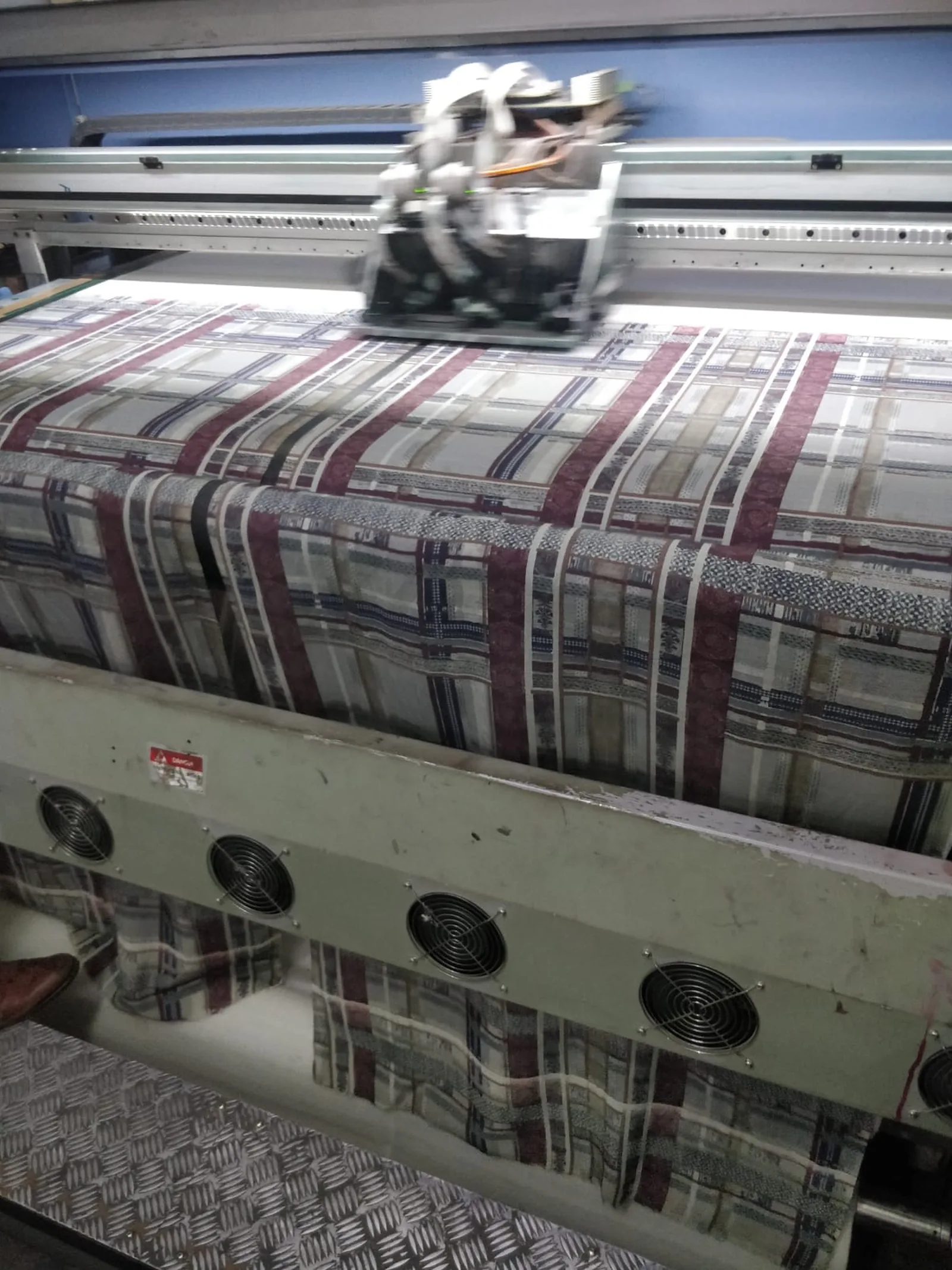
Why does print-through vary by fabric?
Print-through varies because light, open cloth holds less fibre between the two faces, so colour reaches the back quickly. Thick cloth absorbs ink in its upper layers and much less reaches the other side.
How does typical weight relate to print-through?
For print-through, the table below gives the figures. Sorted by typical gsm from our fabric data. A general trend, because weave matters too.
| Fabric | Typical gsm | Expected show-through |
|---|---|---|
| silk habutai | 22-69 | Strong |
| polyester chiffon | 40-60 | Strong |
| silk twill | 52-69 | Some |
| silk crepe | 52-69 | Some |
| cotton voile | 60-80 | Strong |
| cotton muslin | 60-90 | Strong |
| silk satin | 69-95 | Some |
| cotton cambric | 80-100 | Some |
| peach-finish polyester | 80-120 | Modest |
| polyester satin | 90-120 | Modest |
| cotton poplin | 100-130 | Modest |
| viscose rayon | 100-130 | Some |
| modal | 100-130 | Some |
| polyester crepe | 100-140 | Some |
| knitted polyester | 100-115 | Strong |
| rayon crepe | 110-140 | Some |
| lyocell (Tencel) | 110-150 | Modest |
| cotton slub | 120-160 | Modest |
| cotton satin | 120-160 | Modest |
| linen | 120-200 | Face stays stronger |
| linen cotton | 120-180 | Face stays stronger |
| polyester spun | 120-180 | Face stays stronger |
| cotton lycra | 160-220 | Face stays stronger |
| cotton twill | 180-250 | Face stays stronger |
| polyester lycra | 180-250 | Face stays stronger |
| polyester canvas | 200-300 | Face stays stronger |
| cotton canvas | 250-400 | Face stays stronger |
Is print-through a fault?
Print-through is not a fault in itself: it is what a dupatta or flag needs, as both faces are seen. It only matters when the reverse is on show and a paler back looks wrong, such as on a scarf hem.
How do you get a design right on both sides?
To avoid print-through limits, stitch two printed layers back to back, as double-sided flags are made. This stops text from reading mirrored, though the piece becomes heavier and stiffer.