What decides how a fabric will drape?
Drape depends on how easily yarns bend and slide past each other, so fine, flexible fibres and loose or crepe yarns hang softly. A firm, tightly woven cloth stays crisp even at a low weight.
Which fabrics are crisp, soft or fluid?
For drape, the table below gives the figures. Grouped from our fabric data; a general guide to each base.
| Drape | What it means | Fabrics |
|---|---|---|
| Crisp | Holds a neat shape, stands away from the body | cotton poplin, cotton twill, cotton canvas, linen, linen cotton, tussar silk, polyester roto, polyester canvas |
| Soft | Bends easily, some body | cotton cambric, cotton voile, cotton slub, cotton satin, cotton muslin, cotton lycra, silk habutai, silk tabby, silk twill, wool pashmina, peach-finish polyester, polyester spun, knitted polyester, polyester lycra |
| Fluid | Falls in close, moving folds | viscose rayon, rayon crepe, modal, lyocell (Tencel), silk satin, silk crepe, polyester satin, polyester chiffon, polyester crepe |
Which products need the most drape?
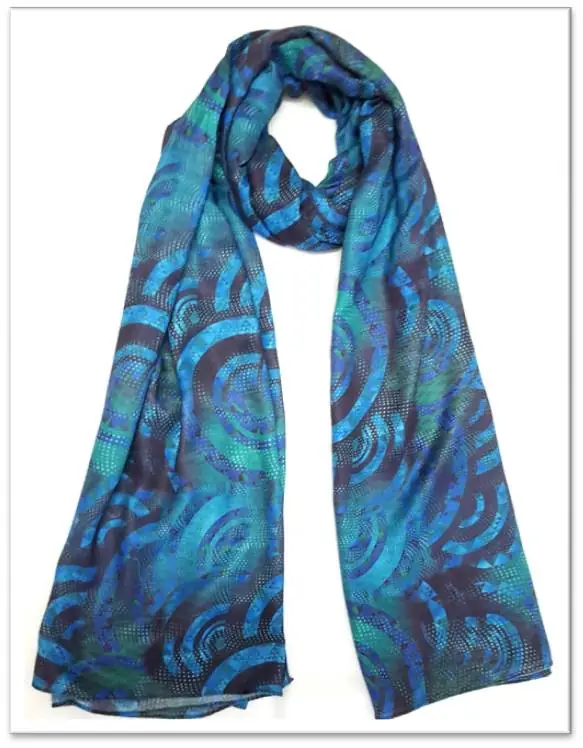
Kaftans, hijabs and long scarves need the most drape because the folds are the look. Aprons, tote bags and table linen ask for the reverse, since they should keep their shape in use.
Does printing change fabric drape?
Dye-based printing barely changes drape because no film forms on the surface. A heavy pigment layer can stiffen cloth slightly, which is one reason soft fabrics are usually reactive printed.