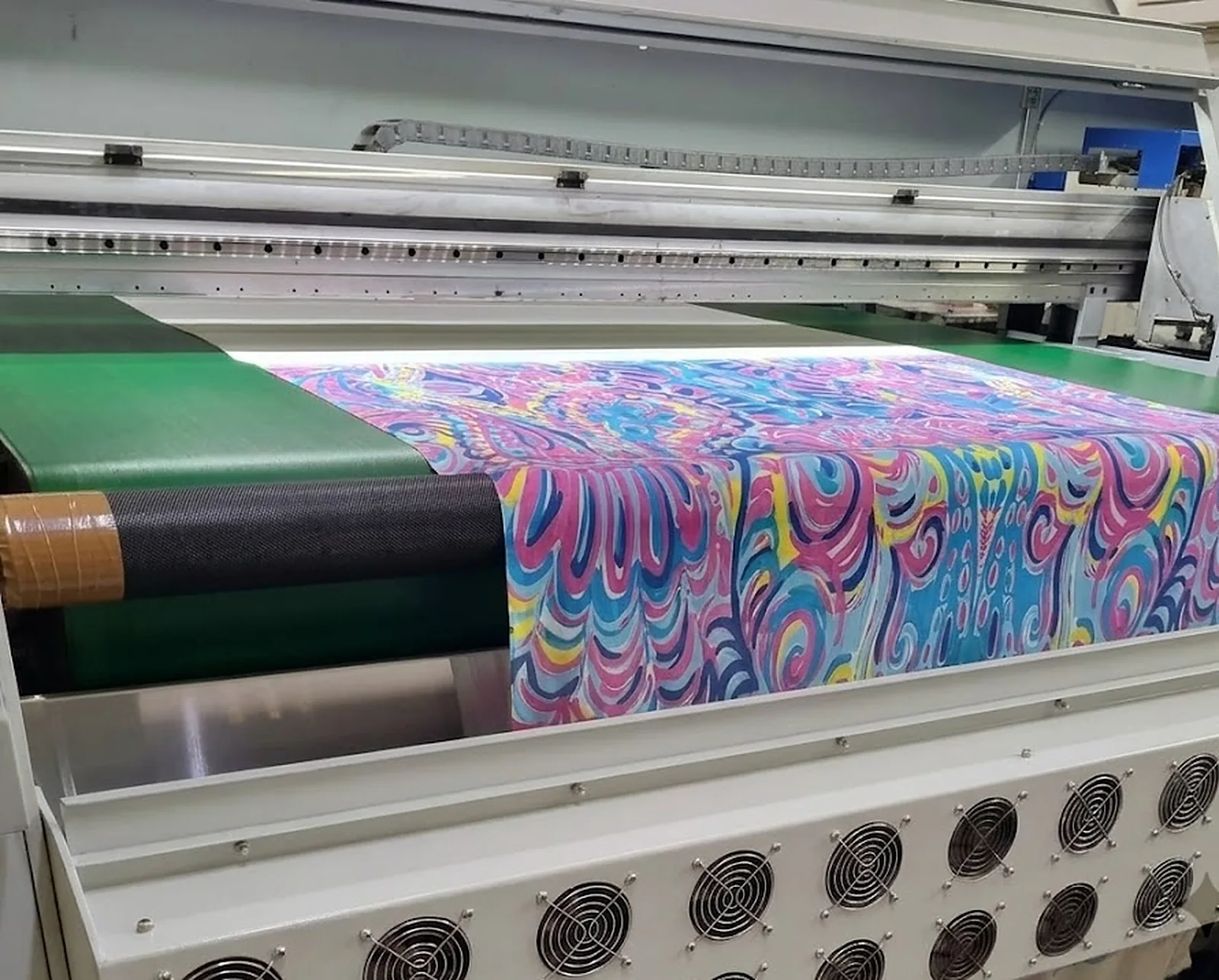
Digital printing on fabric means printing a design from a computer file straight onto textile with an inkjet printer made for fabric. There are no screens, so any number of colours, photographic detail and gradients print at no extra set-up cost, and a design can be sampled, changed and printed again quickly. HM International runs this process at its own unit in Okhla Industrial Area Phase II, New Delhi, on Japanese machines.
How digital printing on fabric works, step by step
- Design file. The artwork is prepared at the size it will print, as a repeat for running fabric or as a placement for a scarf or garment panel. High-resolution JPG, TIFF, PDF, PSD or AI files work best.
- Choose the fabric and the ink. The ink is matched to the fibre: reactive dyes for cotton and viscose, acid dyes for silk, wool and nylon, disperse or sublimation dyes for polyester, and pigment inks for many fabrics and blends.
- Prepare the fabric. Fabric for dye-based printing is usually pre-treated so the ink stays sharp and the colour fixes properly.
- Print. The fabric runs under the print heads on the machine’s belt and the design is printed directly onto it.
- Fix the colour. Depending on the ink, the colour is fixed by steaming and washing (reactive and acid dyes) or by heat (pigment and sublimation).
- Finish. The printed fabric is dried and finished, then cut, stitched, labelled and packed if it is becoming a product.
Which fabrics can be digitally printed?
Natural, synthetic and blended fabrics can all be printed with the right ink: silk, cotton, linen, viscose and rayon, modal, wool and pashmina, polyester (including chiffon and georgette qualities), nylon, and blends such as poly-cotton, linen-cotton and silk-wool. See our fabric guide and which ink suits which fabric.
Digital printing vs screen printing
Screen printing needs one screen per colour, so it is economical for long runs of one design. Digital printing has no screens, so it suits samples, short and medium runs, photographic designs and collections with many designs. Full comparison.
Direct digital printing or sublimation?
Direct digital printing prints straight onto natural and blended fabrics. Sublimation (heat-transfer) printing moves dye into polyester with heat and works only on polyester-rich fabric. How they differ.
What decides the cost?
The price of digitally printed fabric depends on the fabric quality and width, the ink and process the fabric needs, the quantity, and the finishing. Because there are no screens, the set-up cost is low, which is why short runs and samples are practical. Send us your design, fabric and quantity for an exact quote.
Get your design printed in Delhi
HM International prints designs for designers, brands, boutiques, manufacturers and exporters, from the first sample to bulk, and can finish them into scarves, stoles, kaftans, bags and cushion covers. Visit us at S-73, Okhla Industrial Area Phase II, New Delhi, Monday to Saturday, 10 am to 7 pm, or send your design. Buyers outside Delhi can order from anywhere in India.